Details of the PSMRE Layout

Details of the PSMRE Layout |
|
In this section we present details, statistics and status of the PSMRE layout. Construction started in 1996. By 1999 most of the track and wiring was complete enough to operate trains, but scenery was still a work in progress. As 2001 rolled by, much of the scenery was complete and museum visitors were enjoying the skill and labors of our fine model craftsmen. Currently the layout has matured to the point of being considered finished. While there are still projects underway, including scenery details, a few buildings left to be constructed and ongoing electrical projects, the layout is fully functional and to most visitors appears to be finished work of art. In fact our focus has shifted from "build and operate" to "operate and maintain". You may enjoy looking at pictures of some of the work in progress over the years, and just below is a diagram of the track plan.
Track Plan
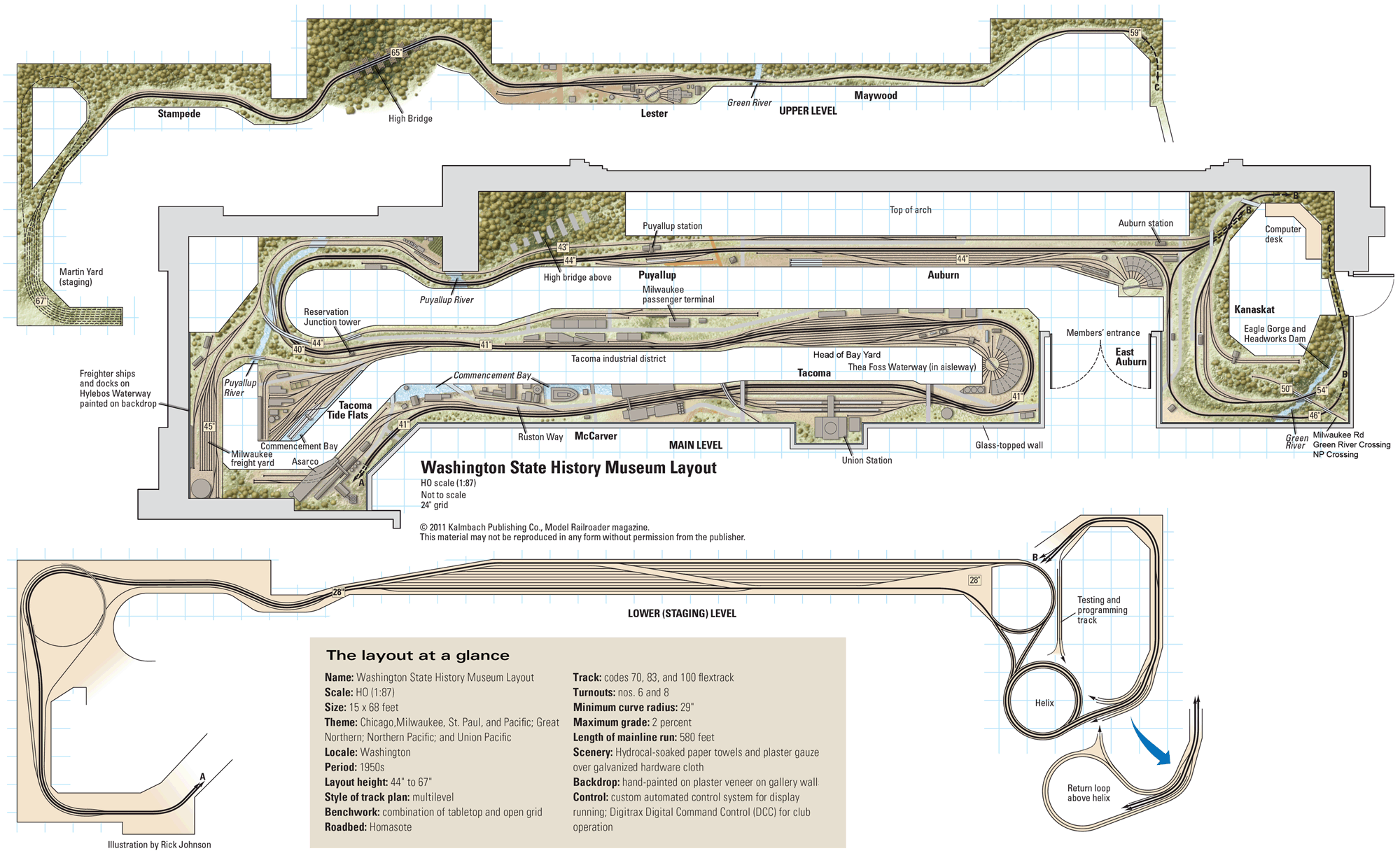
Here is a track plan, which is scanned from our brochure. You can click on the picture below to get a bigger version which is a little clearer. For the advanced reader, print out a copy or open a second window in your browser, so you can refer to the diagram during the following description!
Not shown on track plan: there is a work / office / storage room (approx. 350 sq. ft.) which can be reached by a door from the public viewing area at the lower right end of the diagram, and from the duck-under in the middle of the right end of the layout, down and right from the CTC panel.
It went which way?
Many railroads tended to designate their tracks as east or west bound. The idea was to make things easier for employees, since the actual tracks often wind around enough that a given track might go in any direction at a given point! By giving tracks an official designation, much like the highway system, everyone knows what track heads what direction and by tradition, railroads often used east / west! So if you think your local interstate highway has confusing names, consider that in our area, "west" generally meant north by the compass. So "east" means south. A train called Extra 155 West could be heading from Portland to Seattle, almost due north. Confused? So are we sometimes! This mnemonic might help: we're based in the Pacific Northwest, so North is West. Like the railroads themselves, traditions change and these days, BNSF, the railroad that operates the tracks we've modeled, uses north / south. Thus a train headed from Portland to Seattle is referred to as northbound. On our layout, we're stuck in the 1950's so the old east/west system remains.
Deciphering the track plan
Our visible southern or "eastern" end begins as trains exit the Asarco Tunnel (lower left in diagram), pass through Tacoma and continue up to Auburn (just above the double-doors on the diagram).
The general plan provides point-to-point operation, with four logical end points. (1) Portland and (2) Seattle are represented by the main staging yard, and are connected by the long double-track main that covers most of the layout's length. "Portland" is reached by a grade down from the tunnel at Asarco, and "Seattle" by continuing up the main line from Auburn. The wye at Auburn leads to the Stampede Pass line, which terminates in a (3) secondary staging yard representing Yakima (formerly Martin), which is visible in the plan at the lower left edge. There is also a Milwaukee depot just "north" of Head-of-Bay Yard, and tracks from here lead north and represent the (4) Milwaukee system. These tracks actually end up down in the main / lower staging yard as well. So, three of our four off-layout destinations end up in the lower main staging yard.
There are several major on-layout destinations for local sweepers, switching freights, locals from off-layout, or passenger traffic. These include the yards at Auburn and Head-of-Bay (Tacoma), the Milwaukee station house, Union Station, industrial areas at Tideflats and the industries south of Union Station, we refer to as Asarco. Local traffic can originate and terminate at either yard.
The track plan above is not very good at showing the layers of track. There is a helix at the right end, and a grade down at the left end, to the main staging yard beneath the rear section (below Auburn and the area to the left of Auburn). The right downgrade is entered just about at Asarco, where the main goes "south" into the Asarco tunnel. The right end (west) is more complicated; the wye at Auburn allows trains to go north (west) to Seattle staging via the helix, and the other leg of the wye goes to east (east, yes actually east) to Stampede Pass. The Stampede Pass track is on a higher level and after looping around the dispatch area, heads along the back wall all the way to the yard on the left end of the layout (currently called Martin).A priority for our orginazation is the operation of trains during the times we are not operating the layout. This is of course is the vast majority of the time the layout is open to the public, since our operating sessions occur only once a month. For auto-train operation (that is, unattended display operation) there are return loops that keep the mainline trains from entering the staging yard. Trains heading to Portland reappear from Portland without ever reaching the grade down to staging, and similar for Seattle. We run five trains in the "auto loop" barring equipment problems.
This auto loop is a top priority, and represents our single most significant committent to the museum. We are very careful with any work that effects the mainline. Maintaining these locos and cars is key. We also have engineers on call during the week in case of problems. We're a museum exhibit, and we want to show the public working trains when possible. We are also quite proud of the auto-train operation, as this entails running five trains on the same track. A failure of one train will likely bring the system to grinding (and sometimes spectacular) halt.
Currently our method of control involves a system of detection blocks that trigger stop blocks (small sections of track) to turn on and off. This system uses Digitrax's LocoNet® as the communication network. A cycle is started when a museum visitor presses a button outside Union Station. This begins a series of steps that release and stop trains so that each train moves through a portion of the layout. Once all trains are stopped, the sequence can begin again.
A recent addition (2010) is an RDC (passenger rail diesel car) that travels the Stampede line. The RDC is controlled by a computer, triggered by events on the mainlines below. The RDC represents our initial foray into controlling the auto-trains on the mainlines by computer. It is planned that at some point passenger trains will enter Union Station to make their stops and freight trains will stay on the mainlines.
Engineers Departmental Structure
The "Engineers" in Puget Sound Model Railroad Engineers does not refer to a choo choo engineer, but rather a construction engineer. It was clear from the outset that in order to build a world class model railroad, we needed skills and professionalism equal to those of the full scale railroads. To that end the responsiblities of construction were divided up into 6 different departments: Civil, Track, Electrical, Scenery, Equipment and Operations. We call this group the Board of Engineers, which is lead by the Chief Engineer. Currently Marshall Wilson does a fine job of leading this group into our era of "operate and maintain". Because of the transition from build to maintain, our Board of Engineers has been consolidated to Operations, Maintenance and Electrical, with the Track, Scenery, Civil and Equipment departments included in the Maintenance department.
Operations Department
Once a month (the first Saturday of each month) we conduct an operations session. These typically run from 10:30 to 3pm, with the goal of replicating a day's worth of train operations in the Tacoma area somewhere in the mid 1950's.
These sessions typically use a Superintendent, Dispatcher, Yard Masters and several train crews. Yard Masters operate the Head-of-Bay and Auburn yards and with sufficient staffing, the Milwaukee yard. The yards accept and build trains, and crews operate these trains for their various jobs. Some of these jobs, include the East Tacoma turn and Yakima turn out of Auburn, and the Tideflats and Asarco turn out of Head-of-Bay. The Milwuakee yard can also require a train crew. Sweeper trains originating in Seattle and Portland (main staging) also run throughout the day, setting out and picking up cars in the two NP yards. Of course the 1950's would be missing something important without passenger trains and we run those according to schedules from our modeled era. Train crews can include an Engineer and Conductor, but typically trains run with a crew of one. Guests or new members will often comprise a two man crew, along with an experienced member and allow us to keep the railroad moving, while giving someone a chance to experience the layout.
In most sessions we communicate using Family Service radios with headsets. Crews contact the dispatcher for permission to depart their terminals and the dispatcher grants authority for movements across sections of the railroad. Currently the Dispatcher keeps track of this with a magnetic train board. Plans are underway to replace or augment the train board with a computer based system. The Dispatcher is aided in tracking trains through the use of Station Masters OS'ing train departures. In actuallity the train crew, puts on a "Station Master's hat" for a moment and performs this function before quickly returning to the task of running the train.
Just how do train crews know what to do with their trains? We use a car card system for controlling the movement of cars, developed by our long time Operations Engineer, Doug Walters. Each car has it's own card with a pocket containing a destination card, which are color coded to aid crews in their jobs as well as labeled with the specific customer. Crews are provided with timetables that help them locate a specific customer. Some jobs are fairly easy, run the train from Portland to Seattle, others are far more complex and challenging. These include tricky switching moves and the need to avoid first class trains while switching from the main. Our system provides a wide menu of train operations to satisfy the variety of interests. If all you want to do is run a train around the main, we've got jobs for you! If you'd like something a little more challenging, we've got those too! For the experienced operators the Yard Master's jobs can be a lot of fun and we're always looking for a good Dispatcher.
Our Operations Department was led by Doug Walters until his passing in 2020. Tom Kenneally, who worked closely with Doug is now our Operations Engineer. Under Tom's guidance, the Operations department meets monthly to address issues, and continues to improve the operations sessions. This department frequently requests the aid of other departments to address problems or make changes to the layout. Most of these are pretty minor now, and frequently involve repairing track or equipment. Before each monthly session this department is responsible for setting up the cards for the next operations day. The cars don't move (at least their not supposed to!) but the destination cards get moved.
A recent addition to the Operations sessions are our Open Operations sessions. These dovetail with the annual Train Festival and occur once a quarter, allowing members to bring their own equipment of any era or railroad. We then enjoy running our personal trains on the NP and Milwaukee mains as well as the Stampede line. Back to Engineers Departmental Structure
Maintenance Department
The Maintenance department is currently lead by Greg Price a fairly new member but experienced and skilled model railroader. The Maintenance department has been given the task of doing the work required to keep the railroad running while upholding the standards and qualities established by the talented and dedicated former engineers of the four consolidated departments below.
Track
Professional railroaders know that good track work is not only essential for smooth operations, but a necessity for a safe work environment. While the stacks are quite so high in the model railroad world, poor track work leads to frustrating Operations sessions and frequent derailments. The PSMRE needs high reliability in order to keep auto trains running. We are quite proud of our Track department, which was led by NMRA Master Model Railroader Gene Swanson until his passing in 2019.
Gene and his crew laid Atlas Code 83 flex track over Homasote. Code 100 was used in hidden track areas, such as the main staging yard. Code 70 track was used in yards and sidings and some industrial sidings received Code 55 track. Turnouts in the hidden areas recieved Atlas Code 100 #5's, most mainline turnouts are Micro-Engineering Code 83 #6's, and Shinohara #8's. There are several scratch built turnouts including two sets of moveable frog crossings at either end of Union Station. All rail joiners are soldered and electrical gaps are filled with styrene and shaped to the rail contour.
By early 1998 the mainline tracks were laid and working, and the Stampede pass line was under
construction. Main staging was done and most of the yards were finished. By 2011, the layout has been fully functional for several years and most track work is now maintenance.
Back to Engineers Departmental Structure
Scenery
As you can see from some of the most recent photos , scenery is largely complete and has been for several years. Most all of the buildings were built to replicate as close as possible, local landmarks from the 1950's, these include the Milwaukee freighthouse and
trestle, the Tacoma Union Station, the Asarco plant, the Meeker Mansion, the Neely Mansion, the Brown and Haley factory, Tacoma and Auburn roundhouses and other distinctive landmarks. The last building of significance was installed in December 2018. Built over a period of 10 years by Gail Hendrickson, Union Station is a masterpiece! A trully remarkable work of art and a focal point to the exhibit. Gail's legacy will remain with us long after his passing in 2019. While buildings, and trackwork are important elements of a great model railroad, other time consuming elements complete the scene. In our case the talented Scenery department was led by Paul Rising, who produced the wonderful scenery elements that distinquish the exhibit. From the fake fur application that represents native grasses, to the forests of trees made and installed by Paul and other members of the Scenery department. The results are trully impressive! Ongoing scenery projects include the addition of lighting, details, people and vehicles. We challenge you to find the Boy Scout camp, a heated hobo discussion and perhaps the occasionall fallen pedestrian. Back to Engineers Departmental Structure Like any good railroad, trains run better when built upon a good roadbed. In a model railroad, the roadbed really starts with the benchwork. At the PSMRE we placed this responsibility under the Civil Department. We were most fortunate to have as it's leader a professional cabinet maker. Bob Stumpf was that man and the bench work he and his crews produced are certainly among the best of any layout anywhere. As the foundation of the layout, the benchwork was largely completed early in the process and most of the work now required of the Civil department falls under the category of improvements. Not long age, we changed our card card storage methods and the Civil Department (Bob) did it's normal terrific job. Bob built us a strong foundation, one that will last long after his passing in 2021. Back to Engineers Departmental Structure The Equipment Department has seen several different Engineers. For several years and until his passing in 2021, Al Babinsky led this important group. Initially charged with developing equipment standards and rostering a stable of trains to handle the auto train duties. The Equipment department has now transitioned to largely a maintenance job with the occasional addition of new equipment and the responsibility for approving new member's equipment contributions. Maintenance is no small chore, with the auto trains racking up hundreds of smiles (scale miles) each day, there is a lot to do. Let's not forget the hundreds of pieces of rolling stock and locomotives used for Operations session. This is important work will continue as part of the Maintenance Department. Back to Engineers Departmental Structure
Electrical Department
While the trains won't roll with out tracks, they are equally dependant upon fuel. In our minature world, electricity is the fuel and not just any old electricity but DCC - Digital Command Control. Simply put an AC voltage containing coded commands, instructs decoders installed in locomotives or switch machines and other devices. Our layout uses Digitrax Digital Command Control equipment and the locomotives use a variety of decoders including many sound decoders.
Our Electrical Department has been lead by several different members, until recently by Al Zimmerschied and now Steve Carter. Although the DCC concept was part of the original plan, the electrical plan has changed and evolved over the years.
Currently the layout has 11 power districts, each of which has between 2 and 4 subdistricts, all protected with circuit breaker devices (Power Shields from DCC Specialties). There are also 3 reversing districts controlled by reversing devices from DCC Specialties. The Digitrax LocoNet® is also broken in to districts matching the power districts and controlled by proprietery devices built by a private vendor.
By 2016, nearly all of the turnouts were controlled with Tortoise motors. Most of the Tortoise motors have been retrofitted with proprietery switch decoders. These devices required removing the original Circuitron circuit board and replacing it with the a proprietery circuit board. The smart Tortoise machines can be individually addressed (any address we need), have onboard LocoNet® connections, as well as contacts for switching frog polarity. Control of the switch decoders is through the use of several control panels, located in drawers at various locations around the layout. In addition many areas have local push button contols built into the facia. Control panels were built using the Tower Master product from CML Electronics in England. The last two panels built, were for the main staging yard, using a precursor to LCC (Layout Command Control), called TCSNet (Train Control Systems). When LCC was adopted as an NMRA standard, TCSNet was shelved, but our system lives on.
A recent electrical project that is mostly complete, is the installation of Power Status panel for each of the power districts. These panels display the DCC voltage and amperage in a given district, allow power shutoff to each of the subdistricts, display track power/short circuit status and the status of the 12v accessory bus. The panels include audible and visual short circuit indicators.
Block detection has been an ongoing project during the last few years. Currently nearly all of the layout has occupancy detection through the use of proprietery block detectors. These block detectors are key to our current auto train control system. The presence of a train in six specific trigger blocks allows the system to function. Beyond that, the entire layout is monitored by a computer, we're currently using Railroad & Company's TrainController software. Block detectors are from a private vendor and like the switch decoders, can be addressed individually and have a LocoNet® connection. In addition to computer monitoring of the layout, several panels display track occupancy, including the Yakima (formerly Martin) yard, the helix and ramps leading to the main staging yard and an auto train control panel. This last panel allows operators to visualize the status of the auto train stop blocks and trigger blocks, turn on/off the auto trains control system and prepare the layout for an operations session. It also features a button that sets all the main lines turnouts to the normal position. The panel's features are a credit to the Tower Master circuit board it was built upon.
Signaling the layout is an ongoing project. Physical signals, in the form of semaphores, are in place on the Stampede line and functioning under the APB (Absolute Permissive Block) system used by the NP in the 1950's. Trainorder Signals are also in place at stations on the NP mains and the Stampede line. Tomar semaphores, trainorder signals, searchlight signals and tri-light signals are to be installed. Semaphores were installed using custom 3D printed "hangers". An assembly built on the hangers, including the semaphore, servos and LED drivers were created and tested and installed as a unit through a 3/4" hole. Semaphores are controlled by a Tam Valley Depot's Dual 3-Way Servo controller, designed for semaphores. While signaling exists for the NP Mains and the Milwaukee line in the TrainController software, only a few physical signals have been installed thus far. TrainController is the control system for the signals, sending DCC switch commands to signal drivers using a logic system based on occupancy and turnout positions. Back to Engineers Departmental Structure
Photos
Please see our photo page.

Copyright © 1997-2022 PSMRE. All rights reserved.
The train near the bottom of the page was created by Randal O'Toole of PRPA, used here by license.